
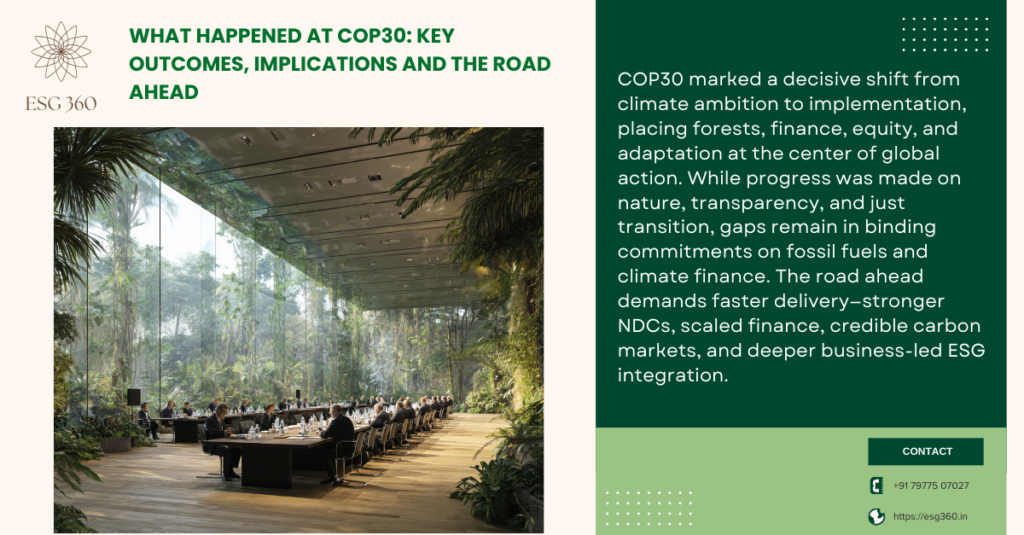
Introduction: A Pivotal Moment in Global Climate Action
The 30th session of the United Nations Framework Convention on Climate Change (UNFCCC) Conference of the Parties COP30 convened from 10 to 21 November 2025 in the city of Belem, in the Brazilian state of Pará, deep in the Amazon region.
Hosting the summit in the Amazon region brought into sharp focus the intersection of climate change, biodiversity, forests, indigenous rights and development. It also raised the stakes for decisions on mitigation, adaptation, finance, nature-based solutions and just transition.
COP30 arrived at a juncture of mounting urgency: global carbon emissions remain high, climate impacts (extreme weather, biodiversity loss, sea-level rise) are escalating, and many pledges remain insufficient to meet the 1.5 °C goal of the Paris Agreement. Ahead of the summit, experts had flagged several themes as critical: realising adaptation and resilience, scaling up climate finance (especially for developing countries), managing the energy transition (including fossil fuel phase-out), strengthening nature and land-use commitments, and enhancing the integrity of carbon markets and disclosures.
In this blog for ESG360, we walk through what transpired at COP30: the major decisions, the negotiations, the breakthroughs and sticking points. We then draw out implications for the global climate agenda and flag what lies ahead.
Setting the Scene: Logistics, Host & Process
Belem, Brazil was selected as the host city, representing the Latin America and Caribbean region. The location in the Amazon underscored the twin imperatives of climate mitigation as linked to forest and land-use change and climate justice, given the vulnerabilities of Indigenous and forest-based communities.
Preparatory sessions in 2025 (the SBSTA (Subsidiary Body for Scientific and Technological Advice)/SBI (Subsidiary Body for Implementation) sessions, pre-COP technical meetings) shaped many of the draft texts that parties negotiated. During the COP, the agenda included multiple streams: mitigation (emissions reductions), adaptation and resilience, climate finance, loss & damage, nature/land-use, just transition, carbon markets & transparency, and the negotiation of next-generation Nationally Determined Contributions (NDCs) under the Paris Agreement.
A key framing device for COP30 was the push to translate the outcomes of the first Global Stocktake (The Global Stocktake (GST) is a five-yearly process under the Paris Agreement (UNFCCC) to assess the world’s collective progress towards climate goals, identifying gaps in emissions reduction, adaptation, and finance to guide stronger national climate plans (NDCs) into implementation i.e., moving beyond ambition setting to action at scale.
Major Themes & Outcomes
Mitigation and the Energy Transition
One of the toughest negotiation areas continues to be the transition away from fossil fuels and the scaling of low-carbon technologies. While COP30 saw positive momentum in several areas, the outcomes remained mixed. Some progress was made on coal, oil and gas, but consensus on concrete binding commitments remained elusive.
For example, a few countries said they would try to cut methane emissions, which is a strong greenhouse gas, especially from the fossil fuel sector. But a news report said that COP30’s progress on methane is very small because most of these promises are optional and not enough.
In terms of land-use and nature, being in the Amazon amplified the focus on forests, deforestation, biodiversity and nature-based solutions (NbS). Host-country Brazil pushed natural capital and forest protection high up the agenda. Meanwhile, many countries repeated that it is important to cut emissions quickly and by a large amount, in a way that keeps global warming limited to 1.5°C, but the gap between commitments and required action remains large.
Adaptation, Resilience & Loss & Damage
Adaptation and resilience efforts were an important focus. The Amazon setting reinforced the vulnerabilities of ecosystems, communities and infrastructure to climate impacts. COP30 emphasised the need for measurable indicators of adaptation progress, although the negotiations revealed differences on how to operationalize this effectively.
On loss & damage (the issue of irreversible impacts of climate change, especially for vulnerable countries), COP30 reaffirmed the urgency of support mechanisms. However, parties remain divided over institutional responsibilities, funding flows, and modalities of action.
Climate Finance: Big Stakes, Big Gaps
Arguably the central battleground of COP30 was climate finance. Developing countries pressed for greater, predictable, concessional finance from developed countries especially for adaptation and loss & damage. A key fact: global climate finance flows hit a record of ~US$1 trillion in 2023, but only about 10 % went to Emerging Markets & Developing Countries (EMDCs), and less than 5 % to adaptation.
Negotiators discussed the fulfilment of previous commitments (e.g., the GCF US$100 billion target) and the mobilization of trillions more in the coming decade. But stark differences remained on definitions, tracking, guarantees, private sector involvement and accountability. Draft texts circulated at COP30 raised concerns among many developing country parties about dilution of finance language.
Nature, Land-use, Forests & Oceans
Hosting the summit in the Amazon region sharpened focus on nature-based solutions. Key themes included forest conservation, biodiversity, land-use change, oceans and the so-called “blue economy”. Some initiatives such as the “Blue NDC Challenge” (to integrate ocean measures into NDCs) were hosted.
Forest finance, deforestation-free supply chains, protection of Indigenous lands, and integrity of climate actions tied to ecosystems were major talking points. The connecting thread: you cannot meet climate goals without nature-positive outcomes.
Just Transition, Equity & Social Dimensions
COP30 emphasised equity, “people-centred” transition, labour, gender and vulnerable populations. Many developing countries, including India, stressed that a just transition one that respects national circumstances and developmental needs must lie at the core of climate policy.
The principle of Common but Differentiated Responsibilities and Respective Capabilities (CBDR-RC) remained central. At COP30, India and other developing countries argued that equity must inform finance, technology transfer, and capacity building.
Carbon Markets, Disclosures & Implementation Machinery
While the Paris Agreement architecture continues to evolve, COP30 also addressed mechanisms for transparency, measurement, verification & reporting (MRV), and the integration of carbon markets. Discussions explored how private capital can be mobilised and how credible carbon credits (including nature-based ones) can be scaled. The “Open Coalition on Carbon Market Integration” was one of the advanced ideas proposed in preparatory work.
The Outcome Document – Wins and Weaknesses
By the close of COP30, parties agreed to a negotiated decision text that acknowledged the urgency of “accelerated implementation”. While this in itself is not new, the focus shifted more explicitly to action-oriented modalities, including setting up work-programmes, technical assistance, and global stocktaking. The host country said that the results of COP30 show it is moving faster on climate action, supporting communities most affected, and turning promises into real progress.
Yet, many observers noted that while language was stronger on adaptation and equity, the actual time-bound commitments (especially on fossil fuel phase-out, methane, finance flows) were weaker than needed to close the Carbon Budget gap. Critics argued that voluntary pledges still dominate, and much of the heavy lifting remains for the years ahead.
Why COP30 Matters: Implications for the Global Agenda
COP30 is significant for several reasons: firstly, it underscores that climate diplomacy is moving deeper into the implementation phase rather than only ambition setting. The emphasis on realising the global stocktaking outcomes means that the next few years are critical. Secondly, the Amazon location signals that forests, nature, indigenous rights and biodiversity are no longer side-topics they are front-and-centre. Thirdly, finance remains the linchpin: without a clear mechanism to scale up flows to adaptation, loss & damage, and developing countries, the entire architecture will struggle. Finally, the social dimension (just transition, equity) is being integrated more firmly into climate talks, recognising that climate action is equally about justice, jobs, and human rights as it is about emissions.
For the broader business and investor community, COP30 sends multiple signals: the pace of regulatory risk is increasing, supply-chain vulnerabilities (linked to nature & adaptation) are magnifying, and the need for credible ESG disclosures and transition strategies is growing. Carbon markets may deepen, but integrity challenges remain. For nature-based solutions, the expectation on companies to go beyond “forest offsetting” toward genuine ecosystem regeneration is rising.
What’s next: From Commitments to Delivery?
The real test lies in the follow-through. Several work-programmes and technical tracks launched at COP30 will run through 2026-2027. Countries must submit updated or new NDCs consistent with 1.5 °C (many are yet to do so). Financing needs to flow not just in headline announcements but with transparency, tracking and accountability. Adaptation indicators must be developed and applied. Carbon markets must be standardised and integrated internationally. And businesses must integrate climate risk into their corporate governance, strategy and reporting, aligning with evolving frameworks like the International Sustainability Standards Board (ISSB).
Closing Reflections
In sum, COP30 reaffirmed that climate change is not a distant threat but a present reality demanding immediate action. The choices made in Belem will resonate across nations, companies and communities. For India and Indian firms, the outcomes of COP30 offer both challenge and opportunity, as we will explore in subsequent blogs. But the fundamental message is clear: the era of talking about climate change is giving way to the era of doing