
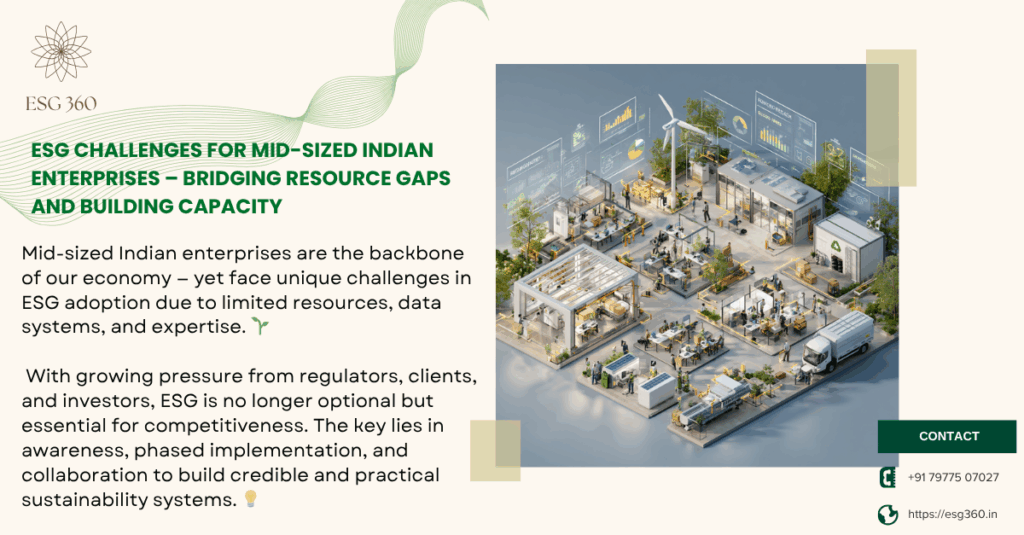
Introduction: The Unseen ESG Struggle of Mid-Sized Companies
As ESG regulations, investor expectations, and stakeholder demands intensify, large listed companies in India are steadily adapting through formal sustainability departments, reporting frameworks, and external consulting partnerships. However, beneath this layer lies a vast segment of mid-sized and small-to-midcap enterprises (SMEs) the silent backbone of India’s economy who face a completely different reality.
For many such companies, ESG is no longer optional. Increasingly, their larger clients and global partners expect disclosures aligned with Business Responsibility and Sustainability Reporting (BRSR), Global Reporting Initiative (GRI), or even ISO-based frameworks. Yet, these enterprises often lack the resources, capacity, and systems required to meet these expectations.
Unlike large corporates, mid-sized firms do not have dedicated ESG teams or robust data collection systems. Their sustainability journey begins not with climate strategy or assurance, but with basic awareness understanding what ESG means, what needs to be measured, and how it can align with their business growth.
This blog explores the unique ESG challenges faced by mid-sized Indian enterprises, and the practical pathways through which they can build capacity and credibility without overextending their resources.
Why ESG Now Matters to Mid-Sized Companies
For a long time, ESG was perceived as relevant only to large, listed entities. That notion has changed dramatically. Mid-sized companies today are under growing pressure to align with sustainability expectations due to several converging forces:
- Supply Chain Pressures:
Large companies, especially those under BRSR Core obligations, now require ESG data from their suppliers and distributors. Mid-sized vendors must therefore track parameters like emissions, waste, and labor practices to retain business partnerships.
- Access to Finance:
Banks and private equity funds increasingly incorporate ESG performance into their risk evaluation models. Strong ESG practices can unlock preferential lending rates, sustainable finance, or inclusion in green investment portfolios.
- Export and Client Requirements:
International buyers often demand sustainability certifications, ethical sourcing assurances, or GHG footprint data as part of procurement due diligence.
- Regulatory Preparedness:
While SEBI’s BRSR currently applies to top 1,000 listed entities, its ecosystem effects are cascading downstream. Mid-sized firms connected to these entities are indirectly drawn into the reporting framework.
In other words, ESG is no longer an optional narrative; it’s a license to operate in modern value chains.
Common Challenges Faced by Mid-Sized Enterprises
Despite understanding ESG’s importance, mid-sized Indian enterprises encounter distinct operational challenges that hinder adoption and reporting:
- Limited Awareness and Clarity
Many organizations still view ESG as an extension of CSR or compliance. There’s limited understanding of how ESG links to profitability, efficiency, and investor confidence. The absence of internal champions leads to fragmented or ad-hoc sustainability efforts.
- Inadequate Data Systems
Data required for ESG metrics such as energy consumption, employee diversity, training hours, or waste segregation often resides in non-standardized formats or is not tracked at all. Manual compilation makes accuracy and comparability difficult.
- Resource Constraints
Unlike large corporations, mid-sized firms may not have budgets for sustainability departments or dedicated ESG officers. Most ESG responsibilities are managed part-time by HR, EHS, or finance personnel.
- Supply Chain Complexity
Many SMEs operate across multiple sites or through extended subcontracting networks. Collecting data or enforcing ESG practices across this fragmented structure becomes challenging.
- Evolving Framework Confusion
With multiple frameworks BRSR, GRI, ISSB, SASB, and CDP companies struggle to determine which is most relevant to them. Lack of alignment leads to inconsistencies and reporting fatigue.
- Limited Access to Expertise
Sustainability expertise remains concentrated in metros and large consulting firms. Smaller enterprises in Tier-2 or Tier-3 industrial zones face difficulties accessing credible ESG consultants or auditors.
These barriers often discourage mid-sized companies from initiating ESG programs, even when leadership is committed.
Bridging the Gaps: Practical Approaches to Building ESG Capacity
While challenges are real, they are not insurmountable. With a phased, practical approach, mid-sized enterprises can establish strong ESG foundations without overwhelming their existing structures.
- Start with Awareness and Leadership Buy-In
ESG initiatives must begin with leadership understanding and endorsement. Conducting internal sensitization workshops helps senior management and department heads recognize ESG as a strategic business opportunity rather than a regulatory burden.
- Conduct a Baseline ESG Assessment
Before designing programs, companies should understand where they stand. A simple diagnostic assessment using BRSR or GRI indicators can help identify strengths, gaps, and priority areas. This establishes a starting point for structured improvement.
- Define Material Focus Areas
Rather than attempting to report on every ESG topic, mid-sized firms should identify their top 8–10 material issues such as energy efficiency, waste reduction, occupational safety, or employee well-being aligned with stakeholder expectations.
- Leverage Existing Systems
In many cases, relevant data already exists in HR records, safety checklists, or financial ledgers. ESG systems can be built by integrating sustainability metrics into these existing operational processes rather than creating entirely new ones.
- Build Cross-Functional ESG Committees
Creating an ESG committee with representatives from HR, Admin, EHS, and Accounts helps share responsibility and ensures cross-functional collaboration. This decentralizes the data collection and review process.
- Use Simple Reporting Templates
ESG reporting for mid-sized companies need not mirror the complexity of large listed entities. Standardized templates aligned with BRSR Lite or simplified GRI indicators can effectively communicate performance and improvement plans.
- Engage with External Partners
Collaborating with ESG consultants, industry associations, and local chambers can provide mid-sized companies access to frameworks, tools, and knowledge that would otherwise be inaccessible individually.
- Plan for Gradual Progress
The goal is not perfection in the first year but consistency and transparency. As systems mature, the scope of disclosures and data quality can progressively improve eventually paving the way for assurance readiness.
The Role of Larger Corporates: Enabling the Value Chain
Large listed companies also have an important role to play in enabling ESG readiness within their value chain. As SEBI’s BRSR Core mandates large companies for the disclosure of value-chain ESG performance individually comprising 2% or more of the listed entity’s purchases and sales (by value) respectively. However, the listed entity may limit disclosure of value chain to cover 75% of its purchases and sales (by value) respectively, such companies must now invest in supplier engagement and capacity building.
This opens a new opportunity for collaboration: mentorship, training, and joint disclosure frameworks between anchor companies and their suppliers. For example, a pharmaceutical manufacturer could train its raw material suppliers on waste segregation and data reporting, while an FMCG brand could develop simplified ESG questionnaires for packaging vendors.
Such collaboration not only strengthens the overall ESG ecosystem but also ensures that sustainability commitments are authentic and measurable across the value chain.
Global Perspective: SMEs and ESG Integration
Internationally, several governments have recognized that small and medium enterprises form the backbone of sustainable growth.
- The European Union’s CSRD encourages large companies to support SME ESG disclosures.
- The OECD and UNEP FI highlight tailored ESG frameworks for SMEs focusing on proportionality and practicality.
- In Asia, Singapore’s ESG Ready Programme and Japan’s SME Sustainability Certification System provide financial and technical support for mid-sized firms adopting ESG.
India’s emerging ESG landscape can follow similar models fostering collaborative ecosystems where smaller companies are empowered rather than excluded.
The Way Forward: Building a Culture of Responsible Growth
ESG integration for mid-sized Indian enterprises is not a matter of size, but of mindset. It’s about building resilience, efficiency, and trust.
When SMEs embed sustainability into their day-to-day operations from resource management to worker safety and ethical governance they future-proof their businesses and enhance their competitiveness.
By starting small, maintaining transparency, and progressively aligning with recognized frameworks, these enterprises can demonstrate credible ESG performance even without large budgets. The journey may be incremental, but each step contributes to India’s collective sustainability transformation.
Conclusion: ESG360’s Commitment to Empowering Mid-Sized Enterprises
At ESG360, we understand that mid-sized companies face unique challenges in navigating the ESG transition. Our approach focuses on capacity building, phased implementation, and simplification helping companies establish foundational systems that grow with their business.
We assist clients in:
- Conducting baseline ESG assessments and gap analyses.
- Identifying material focus areas and realistic targets.
- Designing simple yet credible data management and reporting structures.
- Training internal teams for self-sustained ESG governance.
Our goal is to make ESG accessible, affordable, and achievable enabling India’s mid-sized enterprises to participate confidently in the sustainability economy.
Because when every business, big or small, embraces ESG, sustainability becomes not just a policy but a practice.