
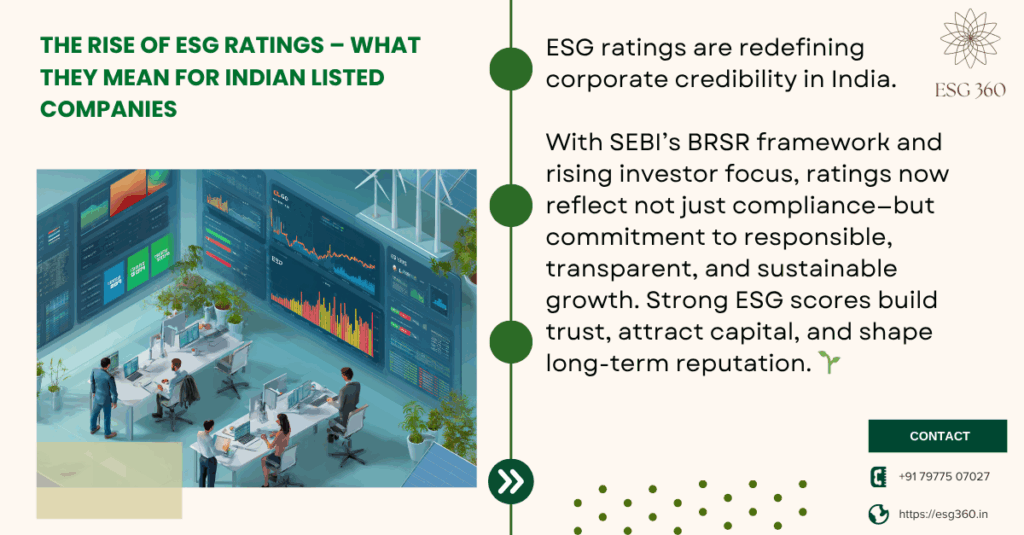
Introduction: ESG Ratings and the New Corporate Scorecard
As environmental, social, and governance (ESG) considerations become mainstream in corporate strategy and investor decision-making, ESG ratings have emerged as a powerful tool to assess corporate sustainability performance. Much like credit ratings evaluate a company’s financial soundness, ESG ratings evaluate how responsibly it operates from its carbon footprint and waste management practices to labor welfare and board diversity.
In India, the conversation around ESG ratings has accelerated significantly since the rollout of SEBI’s Business Responsibility and Sustainability Reporting (BRSR) framework. Rating agencies such as CRISIL, CareEdge, ICRA, Acuité, and international firms like MSCI, Sustainalytics, Refinitiv, and Moody’s have started assigning ESG scores to Indian corporates based on publicly available disclosures and additional data inputs.
For companies, this marks both an opportunity and a challenge. On one hand, strong ratings enhance reputation, investor confidence, and access to green finance. On the other, poor or inconsistent ratings can raise concerns about data quality, governance, and credibility even if the underlying intent is sound.
Understanding how ESG ratings work, what influences them, and how companies can improve their standing has become crucial in India’s evolving sustainability landscape.
What Are ESG Ratings and How Are They Determined?
An ESG rating is a quantitative or qualitative assessment of a company’s environmental, social, and governance performance. Rating agencies evaluate publicly disclosed data such as BRSR reports, sustainability reports, annual reports, and regulatory filings — alongside information gathered from stakeholder surveys, third-party databases, and direct company interactions.
Each agency applies its own methodology, but typically considers three broad dimensions:
- Environmental: GHG emissions, energy efficiency, water use, waste management, pollution prevention, biodiversity impact.
- Social: Labor practices, employee safety, diversity and inclusion, human rights, community development.
- Governance: Board composition, ethics and anti-corruption measures, transparency, shareholder rights, executive remuneration.
The final score is usually expressed on a scale (for example, from AAA to CCC or 1 to 100) and indicates relative ESG performance compared with peers in the same sector.
Different agencies may assign different scores to the same company, depending on their weightage models, data sources, and evaluation criteria. This variation often confuses stakeholders but it also highlights the importance of data consistency, transparency, and contextual reporting.
Why ESG Ratings Matter More Than Ever
For Indian corporates, ESG ratings have evolved from being symbolic to being strategically significant. They are now a tangible reflection of corporate responsibility and resilience in the eyes of investors, regulators, and consumers.
- Investor Decision-Making:
ESG ratings are increasingly used by domestic and foreign investors to screen portfolios, price capital, and evaluate long-term risks. A higher rating signals better risk management, while a poor one can deter ESG-focused funds or raise capital costs.
- Regulatory and Policy Alignment:
Although SEBI has not yet mandated public ESG ratings, the BRSR framework has indirectly fueled their growth by standardizing disclosures. As India moves toward BRSR Core assurance, ratings will gain further importance as an external validation of ESG maturity.
- Corporate Benchmarking:
Ratings allow companies to benchmark their ESG performance against peers, identifying gaps in environmental efficiency, social responsibility, and governance oversight.
- Market Reputation and Stakeholder Trust:
A strong ESG score enhances brand perception, making companies preferred partners for clients, investors, and employees. Conversely, weak ratings can lead to reputational risks, especially when discrepancies between reported data and actual performance are exposed.
The Indian Landscape: Rise of Domestic ESG Rating Agencies
India has witnessed the rapid emergence of domestic ESG rating agencies that blend international frameworks with Indian regulatory nuances.
CRISIL Ratings launched its ESG scoring methodology in 2021, covering over 500 companies. Its framework evaluates policy strength, implementation effectiveness, and disclosure quality.
CareEdge Ratings introduced its ESG Rating Matrix, assigning scores across 300+ companies, emphasizing industry materiality and transparency.
ICRA and Acuité have also initiated ESG scoring products aligned with SEBI’s disclosure requirements.
These domestic agencies rely heavily on data disclosed through BRSR reports, annual filings, and sustainability reports. Hence, companies that invest in clear, complete, and verifiable ESG disclosures naturally perform better in such evaluations.
Global Benchmarks and Divergence
Globally, leading ESG rating providers MSCI, Sustainalytics, Refinitiv, FTSE4Good, and S&P Global dominate the landscape. However, their methodologies differ substantially, leading to what experts call the “ESG rating divergence problem.”
A single company may receive a top score from one agency and a below-average score from another. For example, while one rater may emphasize governance and risk disclosure, another may prioritize carbon footprint or labor safety.
This divergence has prompted investors to cross-verify multiple sources before forming a complete ESG view. For Indian companies, it underscores the need for consistent disclosures, data traceability, and clear contextual explanations in BRSR or sustainability reports.
How ESG Ratings Interact with BRSR Disclosures
The BRSR framework has provided a uniform disclosure baseline for Indian companies. However, ESG rating agencies interpret these disclosures through their own lenses.
For example:
- Under Principle 6 (environment), agencies may extract GHG, waste, and water intensity data to score environmental performance.
- Under Principle 3 (employees), they may review diversity ratios, occupational safety incidents, or training hours.
- Under Principle 1 and 5, they may assess governance practices and ethical conduct.
Incomplete or ambiguous BRSR disclosures often translate into lower ESG scores, even if internal practices are robust. Therefore, the quality and clarity of disclosures not just their existence determine how rating agencies perceive a company’s ESG maturity.
Key Drivers of ESG Rating Performance
Through analysis of recent Indian ratings, five common performance drivers emerge:
- Data Transparency and Consistency
Agencies reward companies that disclose year-on-year trends, comparative data, and methodology details. Unexplained fluctuations in metrics or missing data periods can negatively impact scores.
- Materiality Focus
Prioritizing material ESG topics and linking them to business strategy enhances rating strength. Superficial or overly generic disclosures dilute impact.
- Quantitative Targets
Setting measurable, time-bound targets (e.g., “Reduce Scope 2 emissions by 15% by FY2026”) signals accountability and forward planning.
- Governance Oversight
Board-level ESG committees, transparent remuneration policies, and anti-corruption measures significantly strengthen governance scores.
- Independent Verification
Third-party assurance or internal audits improve data reliability and demonstrate commitment to transparency, an increasingly weighted factor under both BRSR Core and rating methodologies.
Challenges and Misconceptions around ESG Ratings
Despite their importance, ESG ratings in India face several challenges:
- Methodology Differences: Companies often question why ratings differ across agencies. This variation is inherent but can be minimized through disclosure clarity.
- Limited Data Availability: Many mid-cap or privately held firms lack comprehensive public ESG data, which lowers their rating potential.
- Perception of Ratings as “Grades”: ESG ratings are dynamic reflections of data quality and risk exposure, not absolute verdicts of corporate ethics.
- Greenwashing Risks: Overstating ESG initiatives without evidence can backfire if ratings or assurance reviews expose inconsistencies.
Understanding these nuances allows companies to treat ratings as a feedback mechanism rather than a final judgment.
Strategies to Improve ESG Ratings
Companies seeking to strengthen their ESG ratings should focus on three dimensions – reporting quality, operational performance, and verification.
- Strengthen Disclosures:
Ensure all BRSR sections are comprehensive, supported by quantitative data, and aligned with frameworks like GRI or ISSB for global comparability.
- Enhance Internal Governance:
Assign ESG oversight at board or executive level, ensuring accountability for disclosures and progress tracking.
- Set Public Commitments:
Declare measurable ESG goals and link them to key business metrics. Transparent progress reporting is valued highly by rating agencies.
- Engage with Rating Agencies:
Proactively communicate clarifications and updates to ensure raters have accurate, contextual information, especially where disclosures alone may not capture the full story.
- Prepare for Assurance:
With BRSR Core mandating limited assurance, companies that maintain audit-ready ESG data will automatically enhance their rating credibility.
The Broader Impact: From Ratings to Reputation
As ESG data becomes a key determinant of corporate reputation, ratings serve as a visible shorthand for stakeholders to gauge credibility. Companies with high ESG scores attract patient investors, talent, and business partners, while those with weak or inconsistent ratings face scrutiny.
Importantly, ESG ratings are not static; they evolve as corporate disclosures mature. Each reporting cycle is an opportunity to improve through better data quality, transparent narratives, and measurable outcomes.
Over time, ESG ratings may influence not just investor decisions but also lending terms, insurance premiums, and even procurement preferences. In this context, proactive ESG management is not just risk mitigation- it’s strategic foresight.
Conclusion: ESG360’s Role in Enhancing ESG Rating Readiness
At ESG360, we work with clients to strengthen the link between ESG reporting, performance, and ratings. Our approach focuses on data accuracy, disclosure clarity, and framework alignment, ensuring that each ESG statement reflects verifiable impact.
We help organizations:
- Conduct detailed ESG rating diagnostics to identify improvement areas.
- Align BRSR and GRI disclosures for rating comparability.
- Design ESG data systems and verification processes aligned with BRSR Core assurance.
- Engage value chain partners for holistic reporting coverage.
Our goal is to help companies build credibility, not just compliance enabling them to navigate the ESG rating landscape with confidence and integrity.
Because in the new era of responsible business, your ESG rating is more than a number – it’s your reputation.