
Introduction: ESG Is Entering Investment Conversations
For a long time, ESG within Indian companies was largely driven by regulatory requirements and internal reporting needs. The focus was on preparing disclosures, aligning with frameworks, and gradually building sustainability practices. However, a significant shift is now taking place in how ESG is being evaluated.
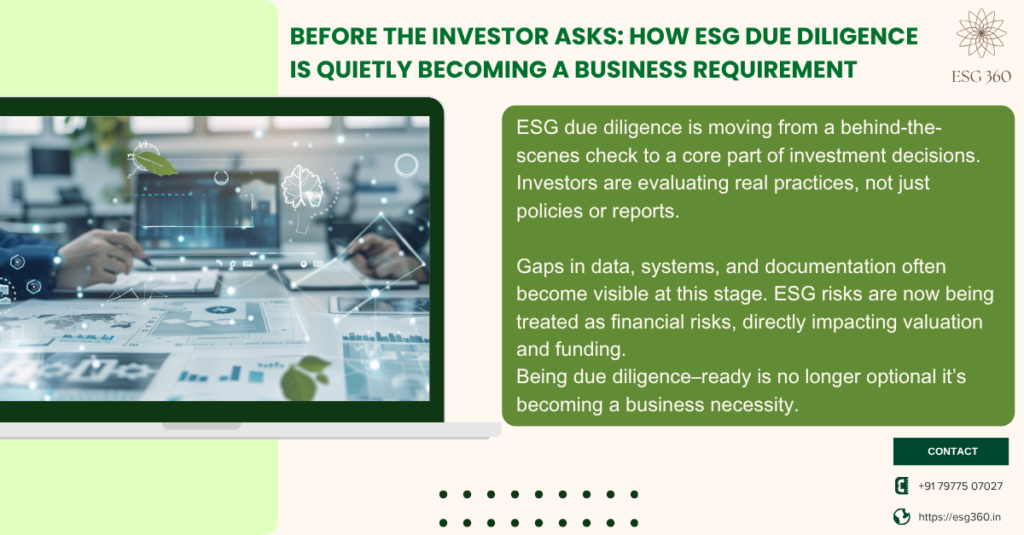
ESG is no longer confined to reports. It is increasingly becoming a part b, often before companies formally present their ESG disclosures.
Investors, private equity funds, lenders, and strategic buyers are beginning to evaluate ESG performance as part of their decision-making process. This evaluation is not limited to reviewing published reports. It involves a deeper examination of risks, systems, practices, and the ability of a company to sustain its operations responsibly.
This shift has given rise to ESG due diligence as a critical business requirement.
Understanding What ESG Due Diligence Involves
ESG due diligence is a structured assessment of a company’s environmental, social and governance practices, conducted as part of an investment, acquisition, or lending decision.
Unlike ESG reporting, which is prepared by the company itself, due diligence is carried out by or on behalf of the investor. It is designed to identify potential risks, gaps, and areas of concern that may affect the value or sustainability of the investment.
The scope of ESG due diligence can vary depending on the sector, size of the transaction, and investor priorities. However, it typically includes an evaluation of environmental compliance, labour practices, governance structures, supply chain risks, and the overall maturity of ESG systems within the organisation.
What makes ESG due diligence different from reporting is the level of scrutiny. It is not based on what is disclosed, but on what can be verified and demonstrated in practice.
Why ESG Due Diligence Is Becoming Important Now
The increasing importance of ESG due diligence is driven by multiple factors.
Investors are becoming more conscious of long-term risks associated with environmental and social issues. Regulatory requirements are expanding, and non-compliance can result in financial penalties, operational disruptions, and reputational damage.
In addition, global investors and multinational corporations are applying stricter ESG criteria across their portfolios and supply chains. This means that Indian companies seeking investment or partnerships are expected to meet higher standards of transparency and accountability.
There is also a growing recognition that ESG performance is linked to financial performance. Issues such as resource inefficiency, labour disputes, governance failures, or environmental violations can directly impact profitability and valuation.
As a result, ESG due diligence is no longer an optional exercise. It is becoming a standard part of investment decision making.
What Investors Are Actually Evaluating
When investors conduct ESG due diligence, they are not simply looking for policies or statements. They are assessing whether ESG considerations are integrated into the company’s operations and decision-making processes.
For example, in the environmental dimension, investors may examine whether the company complies with applicable regulations, how it manages emissions, water usage and waste, and whether there are any past incidents or liabilities.
In the social dimension, the focus may be on employee safety, labour practices, diversity, and relationships with local communities. Investors may look for evidence of training programs, grievance mechanisms, and compliance with labour laws.
From a governance perspective, the evaluation often includes board structure, internal controls, ethical practices, and transparency in decision making. Issues such as related party transactions, conflict of interest, and whistleblower mechanisms may also be examined.
The key point is that investors are looking for evidence of implementation, not just intent.
The Gap Between Perception and Reality
Many companies believe that having an ESG policy or publishing a report is sufficient to demonstrate their commitment. However, ESG due diligence often reveals gaps between what is stated and what is actually practiced.
For instance, a company may have a sustainability policy in place but lack measurable targets or monitoring systems. It may report on employee well-being but not have structured processes for tracking incidents or addressing grievances. It may claim to engage with suppliers but have no formal mechanism for assessing supplier ESG performance.
These gaps may not be visible in standard disclosures, but they become evident during due diligence.
This is where companies face challenges. The absence of structured systems, documentation, and evidence can raise concerns for investors, even if the underlying operations are relatively sound.
ESG Risks as Financial Risks
One of the most important developments in ESG due diligence is the recognition of ESG issues as financial risks.
Environmental non-compliance can lead to fines, shutdowns, or remediation costs. Poor labour practices can result in legal action or disruptions in operations. Governance failures can impact investor confidence and lead to valuation discounts.
Investors are increasingly quantifying these risks and incorporating them into their decision making. This means that ESG is no longer treated as a separate or qualitative factor. It is being integrated into financial analysis.
For companies, this creates a direct link between ESG performance and access to capital.
Challenges Faced by Indian Companies
Indian companies, particularly mid-sized organisations, face several challenges in preparing for ESG due diligence.
One of the primary challenges is the lack of formalised ESG systems. Many companies operate with informal processes that are not documented or standardised. While these processes may work internally, they are difficult to present during due diligence.
Another challenge is the absence of centralised data. As discussed earlier, ESG data is often fragmented across departments, making it difficult to provide a comprehensive and consistent view.
There is also limited awareness about what investors expect in terms of ESG. Companies may not be familiar with due diligence frameworks or the level of detail required.
These challenges can create delays, increase transaction complexity, and in some cases, impact the outcome of investment decisions.
Moving Towards Due Diligence Readiness
To prepare for ESG due diligence, companies need to adopt a proactive approach.
This begins with understanding the key ESG risks relevant to their sector and operations. Companies need to identify areas where they may be exposed and take steps to address these risks.
It is also important to establish structured systems for ESG data collection, monitoring, and reporting. This includes defining responsibilities, standardising methodologies, and maintaining documentation.
Governance plays a critical role. Board level oversight, internal policies, and clear accountability mechanisms help demonstrate that ESG is integrated into the organisation’s decision-making processes.
Finally, companies should view ESG due diligence not as a one-time requirement, but as an ongoing process that strengthens their overall resilience and competitiveness.
Conclusion: ESG as a Business Requirement
ESG due diligence reflects a broader shift in how businesses are evaluated. It is no longer sufficient to comply with regulations or publish disclosures. Companies are expected to demonstrate that they have the systems, processes, and governance structures required to manage ESG risks effectively.
For Indian companies, this represents both a challenge and an opportunity. Those that proactively prepare for ESG due diligence will be better positioned to attract investment, build partnerships, and enhance their long-term value.
The key question is not whether ESG due diligence will become relevant. It is whether companies are prepared before it becomes a deciding factor.