
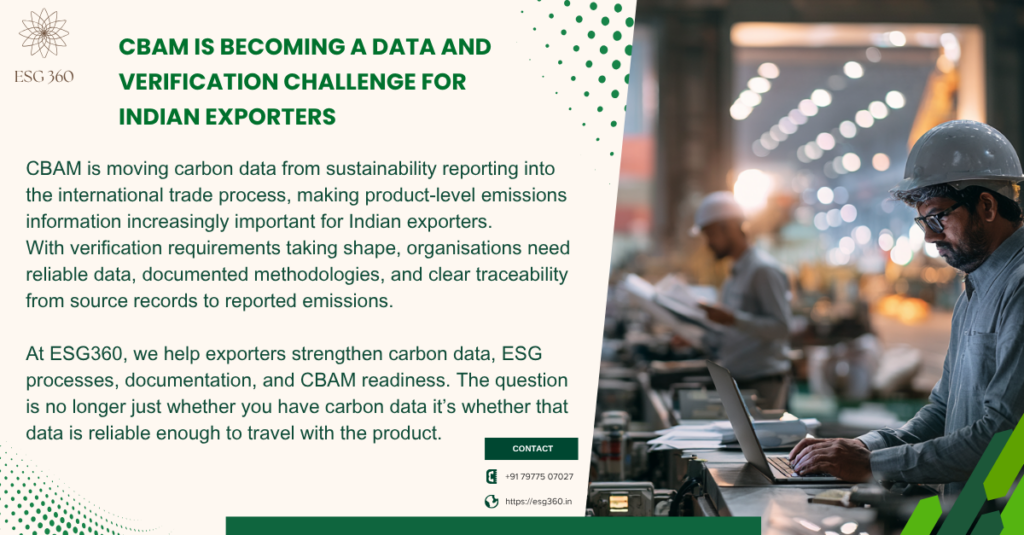
For Indian exporters, climate-related requirements are increasingly becoming part of the conditions of international trade.
The European Union’s Carbon Border Adjustment Mechanism (CBAM) is an important example of this shift. CBAM is no longer only a future regulatory development that companies can monitor from a distance. Its definitive regime came into effect on 1 January 2026 and applies to selected imports of cement, iron and steel, aluminium, fertilisers, electricity and hydrogen. Under the definitive regime, EU importers are required to declare the embedded emissions associated with covered goods and surrender the corresponding CBAM certificates.
For Indian manufacturers and exporters, however, the most important issue may not initially be the purchase of CBAM certificates by the European importer. It is the information that sits behind the export.
The exporter needs to be able to provide credible information about the emissions embedded in the goods being supplied. Where actual emissions are used, the European Commission requires those emissions to be verified by an appropriately accredited independent verifier.
This creates a new challenge for Indian businesses: the carbon information associated with a product now needs to be sufficiently detailed, consistent and traceable to support an international trade requirement.
The question is therefore moving from “Does the company measure its carbon footprint?” to a much more specific question:
“Can the company demonstrate the emissions embedded in the product being exported, using data that can withstand external verification?”
Understanding CBAM Beyond the Carbon Tax Narrative
CBAM is often described simply as a carbon border tax. That description captures part of its economic effect but does not fully explain the operational challenge faced by exporters.
The mechanism is designed to address the carbon emissions associated with certain goods imported into the EU. During the definitive regime, EU importers of covered goods are responsible for declaring embedded emissions and meeting the associated certificate obligations. The price of CBAM certificates is linked to EU Emissions Trading System allowance prices. Where a carbon price has already been paid during production in a third country and the relevant requirements are met, the corresponding amount may be deducted.
The system therefore creates a chain of information extending beyond the European importer.
At one end is the EU importer. At the other end is the installation where the product was manufactured.
Between them sits a significant amount of emissions data.
The manufacturer needs to monitor and calculate the embedded emissions associated with the relevant goods. The importer uses this information for its CBAM declaration. Where actual emissions are reported, the information needs to go through verification by an accredited verifier.
This makes the quality of information generated at the manufacturing facility increasingly important to the export transaction.
The Shift from Corporate Carbon Footprint to Product-Level Carbon Information
One of the most significant changes that CBAM brings to ESG data management is the shift in the level at which emissions need to be understood.
A conventional corporate carbon footprint generally answers questions such as:
How much Scope 1 emissions did the company generate?
How much purchased electricity did the company consume?
What were the organisation’s Scope 1 and Scope 2 emissions during the reporting period?
These remain important questions.
CBAM introduces another layer.
The organisation may need to understand the emissions associated with particular goods produced at a particular installation and exported to the EU.
This means that corporate-level emissions information may not be sufficient on its own.
Consider a manufacturer that produces several products at the same facility. The company’s annual Scope 1 emissions may be accurately calculated. However, an exporter may still need more granular information to determine the emissions embedded in a particular CBAM-covered product.
The organisation therefore needs to connect:
Production data → Energy and process data → Emissions calculation → Product or production-line allocation → Embedded emissions → Export documentation
This is fundamentally a data architecture challenge.
Why Verification Changes the Standard of ESG Data
The introduction of verification is particularly important because it changes the question from whether an emissions figure has been calculated to whether the figure can be independently assessed.
The European Commission’s CBAM verification framework states that verification of actual emissions data must be performed by independent verifiers accredited by EU national accreditation bodies. The verifier assesses the monitoring approach, emissions calculations and supporting evidence at the relevant installation.
This means that a company cannot approach CBAM data as an informal sustainability estimate.
The information needs to be supported by evidence.
For example, if fuel consumption is used to calculate emissions, the organisation should have a reliable source for the fuel quantity. If electricity consumption forms part of the calculation, the relevant consumption records need to be identifiable. If production volume is used to calculate emissions intensity or allocate emissions, the organisation should have a defined methodology and supporting production records.
The calculation itself is only one part of the process.
The underlying evidence is equally important.
The Installation Becomes an Important Point of Control
CBAM verification operates at the installation level where CBAM goods are produced.
According to the European Commission, non-EU installation operators monitor and calculate embedded emissions in accordance with the CBAM methodology and provide the relevant information to an accredited verifier. The verifier reviews the emissions data and supporting evidence before issuing a verification report.
This has an important implication for Indian companies with multiple manufacturing locations.
A central sustainability team may prepare the company’s ESG report. However, CBAM information may originate from individual plants.
The quality of the final information will therefore depend on the systems operating at each relevant installation.
A company with five manufacturing facilities may have five different approaches to recording fuel, electricity, production and process information. If those approaches are not standardised, consolidating the information into a reliable CBAM dataset can become difficult.
The solution is not necessarily to create a new system for every requirement.
Instead, companies should assess whether their existing ESG, energy, production and environmental data systems can provide the level of traceability required.
Documentation Will Matter as Much as the Calculation
One of the most common weaknesses in ESG data management is the separation between the final reported number and the evidence supporting it.
A spreadsheet may contain an electricity consumption figure. But where is the corresponding electricity bill or meter record?
A plant may provide a fuel consumption number. But which register, invoice or ERP record supports it?
A production team may provide output data. But is the definition of output consistent with the methodology being used for emissions calculations?
These questions become more important when information is subject to external verification.
A CBAM-ready data system should ideally allow a reviewer to trace a reported figure back to its source.
For example:
Source document → Activity data → Calculation methodology → Emission factor → Emissions → Embedded emissions → CBAM information
The exact methodology will depend on the product, installation and applicable CBAM requirements. The broader principle remains the same: every material figure should have a clear data lineage.
The Challenge of Emission Factors and Methodologies
Emission calculations can appear straightforward when viewed at a high level.
Activity data is multiplied by an emission factor and the resulting emissions are calculated.
In practice, however, methodological decisions can have a significant effect on the result.
Companies may need to determine which emission factors are applicable, how different fuels are treated, how process emissions are captured, how electricity-related emissions are determined and how emissions are allocated to specific products.
The European Commission has issued guidance for non-EU installation operators on CBAM implementation and specific guidance covering the calculation of embedded emissions. It has also published sector-specific guidance for cement, hydrogen, fertilisers, iron and steel, aluminium and electricity.
This makes methodology management an important part of CBAM readiness.
Companies should not allow different plants or departments to independently interpret the same requirement.
A documented methodology can help establish consistency across reporting periods and facilities.
Upstream Data Can Become a Problem for Downstream Exporters
The challenge becomes even more complicated when a company depends on information from another manufacturer or supplier.
A downstream exporter may use materials or intermediate products whose embedded emissions need to be understood. If the upstream producer does not maintain adequate emissions information, the exporter may struggle to compile the information required for its own CBAM obligations.
This issue is particularly relevant in complex industrial supply chains.
The Indian Government is currently working to strengthen domestic CBAM preparedness. Recent reporting indicates that the Government is also working with the Ministry of Steel to improve emissions data from upstream producers, recognising the importance of reliable upstream information for downstream exporters.
This demonstrates an important broader trend.
Product-level carbon information is gradually becoming a supply chain requirement.
The company exporting the final product may not control every stage of its production chain, but it may increasingly need access to reliable environmental information from other entities.
Verification Capacity Is Becoming an Important Part of India’s CBAM Readiness
Verification is another area where India is currently developing capacity.
The European Commission’s framework requires CBAM verifiers to obtain accreditation through an EU national accreditation body. The Commission’s current timeline indicates that accredited CBAM verifiers can begin registering in the CBAM Registry from September 2026 and can issue verification reports from January 2027.
India is also working to expand its domestic readiness for CBAM verification. Recent reporting indicates that the Government has formed a Committee on Export Preparedness for EU CBAM and that the National Accreditation Board for Certification Bodies (NABCB) is engaging with potential validation and verification bodies. The Government is also seeking greater recognition of Indian accreditation arrangements within the EU framework.
The availability and recognition of qualified verification capacity matters because verification is not simply a final certification exercise.
The verifier needs to assess the underlying monitoring approach, calculations and supporting information.
This makes internal preparedness particularly important for exporters.
CBAM Readiness Should Start Before the Verification
Waiting for a verifier to identify problems is not an effective approach to carbon data management.
Companies should conduct an internal readiness assessment before information enters the external verification process.
This can include reviewing:
- Whether all relevant CBAM-covered products and installations have been identified
- Whether responsibility for CBAM data has been clearly assigned
- Whether activity data is collected consistently
- Whether relevant source documents are retained
- Whether emission factors and methodologies are documented
- Whether production data can be reconciled with operational records
- Whether calculations can be reproduced
- Whether historical data is available where required
- Whether supplier or upstream emissions information is sufficiently reliable
- Whether the organisation has a documented review and approval process
The objective should be to identify weaknesses before they become verification findings.
CBAM Is Also a Commercial Issue
CBAM should not be viewed solely as an environmental compliance matter.
For exporters, carbon performance can become connected with market access, pricing and customer relationships.
A European customer may increasingly want to understand the emissions associated with products purchased from an Indian supplier. Two suppliers offering technically similar products may have different embedded emissions profiles.
This can create commercial pressure for better carbon performance.
It can also create opportunities.
Manufacturers that can demonstrate reliable emissions data may be better positioned to respond to customer requests, participate in low-carbon procurement programmes and communicate their decarbonisation progress with greater credibility.
This does not mean that lower reported emissions automatically translate into a commercial advantage. The impact will depend on the product, customer, market conditions and applicable CBAM requirements.
What is becoming clear, however, is that carbon information is increasingly entering the commercial relationship between manufacturers and international buyers.
From ESG Reporting to Product Carbon Management
CBAM highlights a broader evolution in ESG.
The first generation of corporate sustainability reporting focused largely on the organisation.
How much energy does the company consume?
How much waste does it generate?
What are its Scope 1 and Scope 2 emissions?
How many employees does it have?
The next phase increasingly asks questions about products, processes and supply chains.
What are the emissions associated with this product?
What is the carbon intensity of this manufacturing process?
Which supplier contributes the most embedded emissions?
Can the emissions figure be verified?
Can the company demonstrate the methodology used to calculate it?
This transition has significant implications for ESG teams.
Sustainability professionals will increasingly need to work with production, engineering, procurement, finance, information technology and export teams. Carbon data will no longer sit entirely within the sustainability function.
It will become part of operational information.
What Indian Exporters Should Do Now
For Indian companies exporting CBAM-covered products to the EU, preparation should begin with a structured assessment of current capabilities.
The first priority is applicability. Companies should identify which products, installations and export flows fall within the relevant CBAM requirements.
The second priority is data mapping. Organisations should identify every data point required for their emissions calculations and determine who owns each piece of information.
The third priority is methodology. Companies should document how emissions are calculated and ensure that the methodology is consistently applied.
The fourth priority is evidence. Every significant input should have supporting documentation that can be retrieved during internal review or external verification.
The fifth priority is reconciliation. Energy consumption, production quantities and emissions calculations should be capable of being reconciled with the underlying operational records.
The sixth priority is verification readiness. Companies should assess their data and processes from the perspective of an independent reviewer rather than waiting until the formal verification stage.
Finally, organisations should integrate CBAM into their broader decarbonisation strategy. Improving data quality is necessary, but the ultimate objective should also be to understand where emissions originate and where meaningful reductions can be achieved.
The Bigger ESG Implication
CBAM demonstrates how environmental information is becoming increasingly embedded in international commerce.
The definitive CBAM regime is already in operation. The European Commission has issued detailed implementation guidance for non-EU installation operators and has established the framework for verification and accreditation.
For Indian exporters, this means that carbon data can no longer be treated as information prepared only for sustainability reports.
It may need to support customer requirements, regulatory declarations, verification processes and international trade.
The organisations that are preparing for this shift should therefore look beyond simply calculating their carbon footprint. They should focus on building a reliable product and installation-level data trail that connects operational activity with emissions and ultimately with the products entering international markets.
CBAM is therefore not just a carbon regulation.
For exporters, it is a test of whether environmental data is sufficiently reliable to become part of the trade process.
How ESG360 Supports Organisations
ESG360 supports organisations in developing structured approaches to ESG data, carbon footprint assessment, sustainability reporting and environmental information management.
For exporters facing increasing carbon-related requirements, the focus needs to extend beyond calculating emissions. Organisations need clearly defined methodologies, reliable source data, appropriate documentation, internal review mechanisms and processes that allow reported information to be traced back to its source.
A structured ESG data system can help organisations prepare for increasing expectations around verification and product-level environmental information while also strengthening the quality of their broader sustainability reporting.
As global markets increasingly connect environmental performance with trade, ESG data is becoming part of the business process itself.
The question is no longer simply whether an organisation has carbon data.
It is whether that data is reliable enough to travel with the product.