
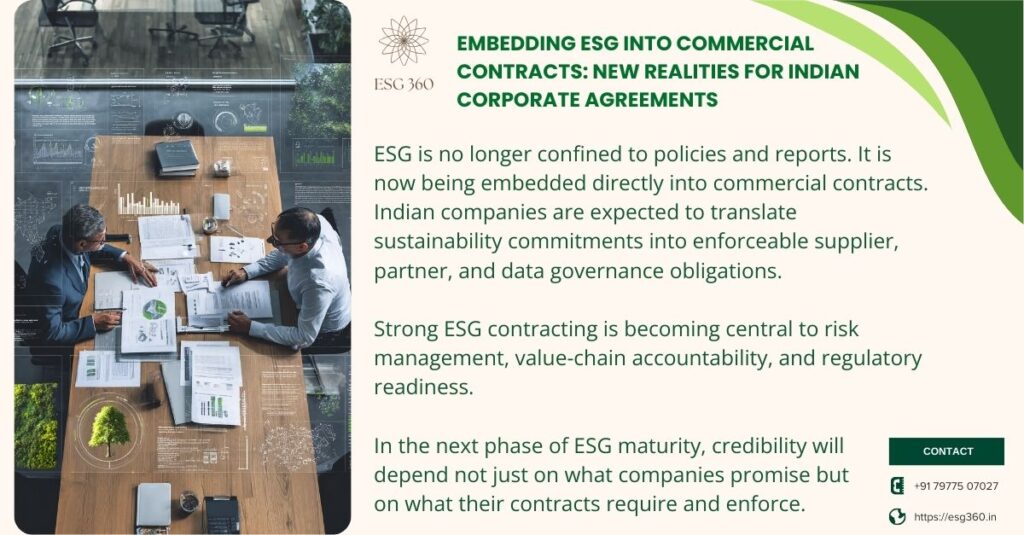
Introduction: Why Contracts Have Become the Hidden Infrastructure of ESG
For many Indian companies, ESG began as a reporting and reputation exercise. Sustainability reports, policies, codes of conduct, and public commitments became the primary ways organisations expressed their responsibility toward the environment, society, and governance. While these instruments remain important, they do not by themselves change behaviour. They describe expectations, but they do not enforce them.
Commercial contracts, by contrast, define obligations.
They determine how suppliers operate, how service providers behave, how partners manage risk, and how accountability is enforced. As ESG expectations deepen across India’s regulatory and business landscape, contracts are emerging as one of the most powerful and often underestimated levers of sustainability governance.
In 2026 and beyond, ESG will no longer be implemented only through sustainability departments. It will increasingly be operationalised through legal frameworks, procurement processes, and contractual controls. Companies that fail to recognise this shift risk having ambitious ESG policies that remain disconnected from commercial reality.
The Evolution of Corporate Agreements
Historically, commercial contracts focused on a narrow set of priorities: price, quality, delivery, liability, and dispute resolution. ESG considerations, if present at all, appeared as brief boilerplate clauses at the end of agreements.
This model is rapidly becoming obsolete.
Today, companies face rising expectations to demonstrate responsible sourcing, ethical conduct, safe working conditions, environmental compliance, data protection, and supply chain transparency. Regulators, investors, and customers increasingly expect companies to show not only what they commit to internally, but how they enforce those commitments across their business relationships.
Contracts are therefore evolving from transactional documents into governance instruments.
They are beginning to define environmental standards, social safeguards, ethical behaviour, data governance responsibilities, audit rights, remediation mechanisms, and termination conditions linked to ESG failures.
This evolution reflects a deeper truth: ESG risks most often materialise not inside boardrooms, but across business networks.
Why ESG Must Be Embedded into Contracts
There are three structural reasons why ESG must now be contractual.
First, regulatory accountability is expanding beyond direct operations. As frameworks like BRSR increasingly emphasise value chain responsibility, companies are expected to monitor, influence, and improve ESG performance across suppliers and partners. Without contractual authority, this is impossible.
Second, risk exposure increasingly arises through third parties. Environmental violations, labour disputes, safety incidents, corruption cases, and data breaches frequently originate with vendors or contractors. Contracts determine whether companies have the right to demand information, conduct audits, mandate corrective actions, or disengage responsibly.
Third, market expectations are formalising. Financial institutions, multinational customers, and institutional investors increasingly require evidence that ESG commitments are enforceable. Contracts are often the first documents examined in due diligence processes.
In this context, ESG clauses are no longer optional reputational signals. They are core components of corporate risk management.
What ESG-Integrated Contracts Now Cover
Modern ESG-integrated agreements address a wide and growing range of issues.
On the environmental front, contracts increasingly require compliance with environmental laws, adherence to company sustainability policies, disclosure of emissions and resource data, responsible waste handling, chemical management standards, and in some cases, alignment with decarbonisation pathways.
On the social front, agreements often specify labour standards, occupational health and safety requirements, working condition expectations, non-discrimination principles, prohibition of child or forced labour, and the presence of grievance redressal mechanisms.
On the governance front, contracts typically include anti-bribery commitments, conflict-of-interest declarations, whistle-blower protections, regulatory cooperation obligations, audit rights, and ethical conduct provisions.
In parallel, data protection and cybersecurity responsibilities are increasingly woven into ESG contracting, recognising that social and governance risks now heavily intersect with digital operations.
Critically, ESG clauses are becoming more structured. They increasingly define documentation requirements, reporting frequencies, monitoring rights, breach classification, remediation timelines, and termination triggers.
The Danger of Superficial ESG Clauses
Despite this progress, many companies still rely on generic ESG language that offers limited real-world protection.
Superficial clauses often suffer from three weaknesses. They are vague, making them difficult to enforce. They are misaligned with internal systems, making them impossible to implement. Or they are unrealistic, creating friction and non-compliance across supplier ecosystems.
Effective ESG contracting cannot be achieved through templates alone.
It requires an understanding of sector-specific risks, regulatory exposure, supply chain complexity, and partner maturity. It requires alignment between sustainability strategy and legal architecture. It requires internal clarity on what the organisation is actually capable of monitoring and enforcing.
Without this foundation, ESG clauses risk becoming symbolic rather than functional.
Organisational Transformation Required
Embedding ESG into commercial agreements fundamentally changes how companies operate.
Legal teams must now engage deeply with sustainability frameworks, regulatory expectations, and ESG risk assessments. Procurement teams must integrate ESG into vendor selection, onboarding, and performance management. Sustainability teams must translate policies into enforceable obligations. Compliance and risk functions must align monitoring, audit, and escalation mechanisms. IT and data governance teams must support secure, transparent information flows.
This cross-functional integration is often one of the most challenging aspects of ESG maturity.
It requires new workflows, shared ownership, leadership sponsorship, and continuous capacity building.
It also requires a shift in supplier engagement philosophy from transactional relationships to partnership models focused on improvement, transparency, and long-term resilience.
Building a Robust ESG Contracting Framework
For Indian companies seeking to future-proof their commercial relationships, ESG contracting must be approached as a system, not a clause.
This begins with internal alignment. Companies must clarify their ESG priorities, regulatory obligations, and risk thresholds. They must define what ESG standards are non-negotiable, what can be phased, and what support mechanisms are required.
The next step is contract architecture. Organisations should develop structured ESG and data governance clause libraries aligned to different contract types, risk categories, and partner segments.
The third step is process integration. ESG requirements must be embedded into procurement workflows, contract approval processes, onboarding programs, and performance management systems.
The fourth step is monitoring and remediation design. Companies must define how compliance will be assessed, how non-conformities will be addressed, how corrective actions will be supported, and when disengagement becomes necessary.
The fifth step is supplier enablement. Training, guidance documents, pilot programs, and communication platforms are essential to ensure ESG contracting strengthens ecosystems rather than destabilising them.
Why ESG Contracting Will Define Corporate Credibility
As ESG regulation matures, companies will increasingly be judged not on what they publish, but on what they can enforce.
Contracts will become primary evidence of governance quality, risk management maturity, and sustainability integration. They will shape investor confidence, customer trust, and regulatory perception.
Organisations that embed ESG into their contractual foundations will be better positioned to manage complexity, respond to crises, and demonstrate credible leadership.
Those that delay may find themselves exposed to risks they cannot control and expectations they cannot meet.
Conclusion: From Legal Formality to Strategic Sustainability Infrastructure
Commercial contracts are quietly becoming the infrastructure of ESG.
They translate values into obligations. They convert policies into processes. They transform sustainability from aspiration into accountability.
For Indian companies navigating the next phase of ESG evolution, the question is no longer whether contracts should reflect sustainability principles. It is whether organisations are prepared to redesign their commercial foundations to support the realities of responsible business.
Those who act now will not only strengthen compliance, but build the governance architecture required for long-term resilience, credibility, and sustainable growth.