
Introduction: The End of the Narrative-Only ESG Era
For much of the past decade, ESG in India has been driven by awareness and intent. Companies published sustainability sections in annual reports, launched CSR programs, articulated values, and aligned themselves with global frameworks. This phase was necessary. It helped place sustainability on boardroom agendas, sensitised leadership, and created a foundation for disclosure.
However, this narrative-driven phase is now giving way to something far more demanding.
Regulators, investors, customers, and even employees are increasingly asking a simple but powerful question: What measurable difference is your company actually making?
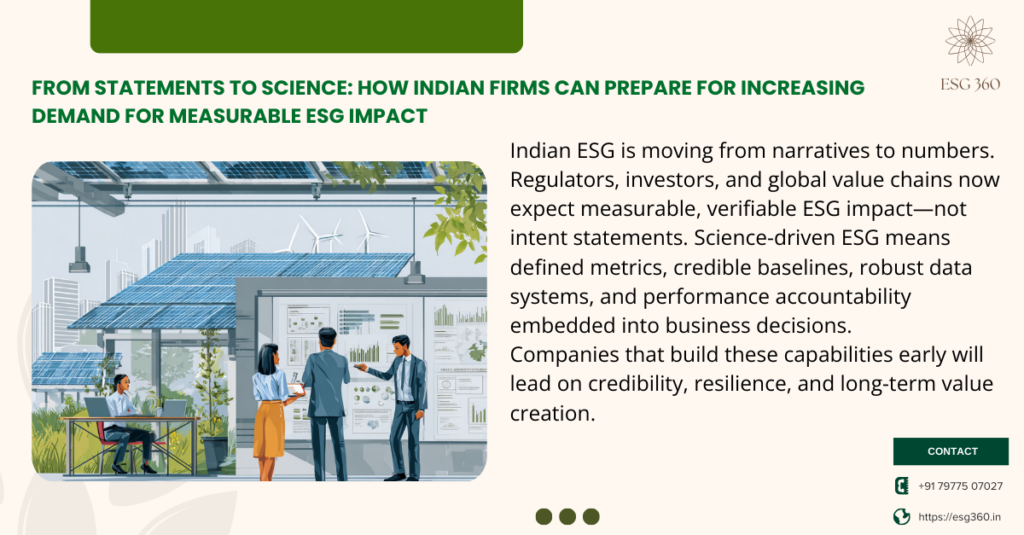
This shift marks the beginning of what can be called the science-driven phase of ESG. In this phase, ambition alone is insufficient. Claims must be backed by quantified baselines. Progress must be tracked through defined indicators. Performance must be verifiable, comparable, and consistent over time.
In India, this transition is visible through the evolution of BRSR, the growing emphasis on BRSR Core metrics, the increasing prevalence of ESG assurance, and the integration of sustainability into financing and procurement decisions. ESG is no longer a storytelling exercise. It is becoming a management discipline.
Why Measurable ESG Impact Is Now Non-Negotiable
The demand for measurable ESG impact is emerging from several converging developments.
Regulatory expectations are becoming more structured. Disclosures are moving from broad descriptions to defined quantitative indicators. Companies are increasingly expected to demonstrate internal controls, data governance mechanisms, and year-on-year performance tracking.
Capital markets are also driving this shift. Investors are integrating ESG risks into valuation models, credit assessments, and portfolio strategies. Without reliable data, ESG information becomes unusable for financial decision-making.
Global supply chains are exerting additional pressure. Indian exporters are being asked to provide emissions data, labour statistics, safety performance records, and environmental compliance documentation. Sustainability is becoming a condition of market access.
Finally, public trust dynamics are changing. Stakeholders are more aware of greenwashing risks. They increasingly expect transparency, evidence, and accountability.
Together, these forces are reshaping ESG from a reputational domain into a performance domain.
The Limitations of the Traditional ESG Approach
Many Indian companies still approach ESG as a collection of disconnected initiatives. Environmental data may sit with EHS teams. Social metrics may be tracked by HR. Governance elements may remain within legal or compliance functions. Reporting often becomes an annual consolidation exercise.
This fragmented model cannot support measurable impact.
Without centralised data ownership, definitions vary across departments. Without standardised methodologies, year-on-year comparison becomes unreliable. Without internal controls, disclosures remain vulnerable to error. Without integration into business planning, sustainability targets remain aspirational.
The result is a growing gap between external expectations and internal capability.
As ESG becomes more quantitative, this gap will become increasingly visible
What “Science-Driven ESG” Really Means
Science-driven ESG does not mean that every company must immediately adopt complex scientific models. It means that sustainability must be treated with the same rigour as financial management.
At its core, this involves five foundational elements.
The first is materiality grounded in evidence. Companies must move beyond generic ESG topic lists and identify the issues that are truly significant to their business, stakeholders, and operating context. This requires structured assessments, risk analysis, and stakeholder engagement.
The second is defined metrics and baselines. For each material issue, companies must establish clear indicators and credible starting points. Whether it is emissions, water intensity, injury rates, gender diversity, or supply chain compliance, performance must be measurable.
The third is data systems and controls. ESG data must be collected through defined processes, validated, stored securely, and reviewed periodically. Over time, these systems should mirror the maturity of financial reporting infrastructure.
The fourth is target setting and performance management. Measurable ESG impact requires clear goals, interim milestones, accountability structures, and integration into management reviews.
The fifth is verification and transparency. As ESG disclosures influence decisions, independent assessment and assurance will become increasingly important to build credibility.
The Strategic Implications for Indian Companies
The movement toward measurable ESG impact has far-reaching implications.
At the governance level, boards will be expected to exercise more active oversight over sustainability risks and performance. ESG committees, integrated risk management frameworks, and sustainability-linked incentives are becoming increasingly relevant.
At the operational level, departments will need to collaborate in new ways. ESG data will intersect with finance, procurement, operations, HR, and IT. Sustainability teams will increasingly act as system designers rather than report coordinators.
At the strategic level, ESG metrics will influence capital allocation, technology investments, product development, and supply chain design. Companies will need to evaluate sustainability initiatives based on impact, scalability, and long-term value creation.
At the reputational level, consistency and credibility will become defining factors. Companies will be assessed not on isolated achievements, but on trajectories, governance quality, and continuous improvement.
Preparing for the Transition: What Indian Firms Must Start Building
The shift to science-driven ESG cannot be accomplished through last-minute reporting exercises. It requires deliberate capability building.
The first capability is ESG architecture. Companies must define clear internal frameworks that link policies, risks, KPIs, data sources, and reporting outputs.
The second is digital enablement. Manual spreadsheets will not sustain audit-grade ESG data. Over time, companies will need integrated platforms, workflow systems, and automated data capture mechanisms.
The third is skills development. ESG teams must expand beyond communications into data management, risk assessment, regulatory interpretation, and cross-functional coordination.
The fourth is leadership integration. Sustainability goals must be embedded into business strategies, operational plans, and performance reviews.
The fifth is external alignment. Companies must engage auditors, consultants, industry bodies, and value chain partners to build consistent, scalable systems.
Why This Transition Will Redefine ESG Leadership
As ESG matures, leadership will no longer be defined by the presence of policies or the aesthetics of sustainability reports. It will be defined by the ability to measure, manage, and improve sustainability performance year after year.
Organisations that invest early in building science-driven ESG systems will benefit from greater resilience, stronger investor confidence, and improved strategic clarity. They will be better prepared for regulatory expansion, value chain scrutiny, and capital market expectations.
Those that delay will find themselves trapped in reactive compliance, constantly trying to retrofit measurement into fragmented structures.
Conclusion: The Future of ESG in India Will Be Built on Evidence
India’s ESG journey is entering a decisive decade. As sustainability becomes integrated into economic policy, financial systems, and global trade, evidence will become the currency of credibility.
For Indian companies, the question is no longer whether ESG matters. It is whether their organisations are equipped to measure it, manage it, and demonstrate it.
The transition from statements to science is not simply a reporting evolution. It is a transformation in how businesses define performance, responsibility, and long-term value.